Showing posts with label setting. Show all posts

Sunday, February 13, 2011

Steampunk Imagery

Steampunk Watchman, steampunk-pics.com
Every writer should have an image library

Looking at art and photography spurs my imagination when I write. The details of other artists' creations spark my creative side, giving me ideas for my own writing: unique touches, emotions, scenes, and plot twists. I develop those sparks into full-fledged concepts and weave them into my stories, making them uniquely my own.

I think every writer should make a habit of collecting images that speak to them. I have an entire library of images that I've collected over the years, including photographs and drawings of people, places, and things. When I'm developing characters, designing settings, or am just plain stuck, I'll flip through my collection. It never fails to inspire me.

For characters, I make a file with the photos and drawings that remind me of the character in some way. Comparing my mental image to real images clarifies my mental picture and nails down the details of the character's appearance and personality. When I sit down to write, I display the pictures that are closest to my mental images on my screen. (My screen is usually half images and I put the MS Word window on the right side.) The images ground me, improve my descriptions, and help me make better and more consistent decisions about what my characters say and do and how they react to events.

The same goes for setting. Looking at setting images while I write helps me pretend that I'm actually there in the scene with the characters. The visual images help me imagine the sights, sounds, tastes, textures, details, and spacial relations as I write. Also, I can't tell you how many maps I've drawn of rooms, ruins, and cities. Even if I don't describe a characters' surrounding in depth, I, as the writer, need to know where everything is spacially so that my descriptions make sense to the reader.

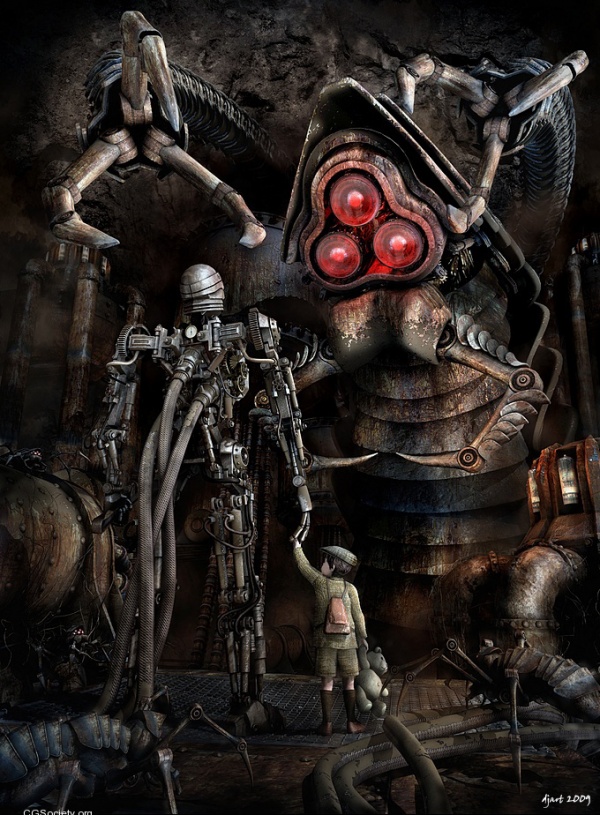
These are a some of the images I've collected as inspiration for our setting. I've also posted more steampunk images on our Social Novel Writing Facebook page.

steampunk-pics.com

http://www.robotvsbadger.com/images/steampunk-girls
Undertakers by Marc17, steampunk-pics.com

steampunk-pics.com

Executors, steampunk-pics.com
Steampunk Mech I by likaspapaya, steampunk-pics.com

http://www.robotvsbadger.com/images/steampunk-girls

Photography by Tyrus Flynn, http://www.flickr.com/photos/tyrusflynn

Photography by Tyrus Flynn, http://www.flickr.com/photos/tyrusflynn

Photography by Tyrus Flynn, http://www.flickr.com/photos/tyrusflynn

Brisingammen by Rasmus Berggreen, steampunk-pics.com

steampunk-pics.com

Clockwork Twins by Tyrus Flynn, http://www.flickr.com/photos/tyrusflynn/

Hall of Souls by Dieter Joppich, steampunk-pics.com

steampunk-pics.com
Sequester, steampunk-pics.com

steampunk-pics.com

http://amatoc.com/articles/steampunk

Steampunk Goliath by Cory Jespersen, steampunk-pics.com

Tyrus Flynn, http://amatoc.com/articles/steampunk

http://www.gizmowatch.com/entry/steampunk-arachnid-steam-powered-six-legged-insect

http://amatoc.com/articles/steampunk

http://amatoc.com/articles/steampunk

http://www.robotvsbadger.com/images/steampunk-girls

Steampunk Monocle, http://www.friedpost.com/sciencetech/the-best-steampunk-gadgets-devices-ever-129.html

Friday, January 14, 2011

Setting developments

Magic and steam technology are mutually inclusive
"The two feed off of each other and can not exist independently." This suggestion stumped me for a while. How could magic not exist without steam technology if steam technology is new and magic existed long before it? I just couldn't wrap my brain around it. Thank you, Plague, for coming up with an answer.

Deep underground, there's a steam magic machine that powers magic [we so need a different name for it though. Any ideas? And where did this thing come from anyway?]. It creates this special kind of steam that has mixed with the atmosphere [should we still call it steam or something else?]. People pull the steam from the atmosphere to fuel their magic. This steam also powers steam technology.
  • At one point, both magic and steam technology existed in the surface world, but for whatever reason [ideas?], steam technology faded out. Now it's reemerging [why now? who's doing it?].
  • People are now finding pipes underground. The concentrated steam makes it so they can create much more powerful magic and machines. [Who's finding the pipes? Who controls it? What affect is this having on the balance of power?]
  • Magic is generally believed to come from within. Even most, if not all, of the magic users don't know that they're pulling steam from the atmosphere.
  • There are steam pockets where the atmosphere feels heavier and magic works better.
  • Magical creatures like faeries and dragons evolved [or were created?] after the steam magic machine began working.
  • If the steam magic machine is destroyed, creatures that are reliant on magic will die (or at least be severely crippled).
  • Faeries are trying to bring down steam technology, not realizing that steam is necessary for them to live.
  • Some people have the ability to pull steam from the atmosphere and create magic; many do not. Steamers can't, but have learned to create machines that do, so now people who can't use magic on their own can use magic through the machines. This is completely shaking up the balance of power in their society.
Races
  • Humans are the most common race in our main city (because, let's face it, we breed like rabbits).
  • Our world also has faeries who are modeled loosely on European folklore, such as the Highland daoine sidhe ("theena shee") and sluagh ("slooa").
  • Gnomes are not faerie folk. According to my research, they are actually earth elementals of the same class as slyphs (air), salamanders (fire), and nereids (water). They belong to a dead science rather than folk tradition. It was believed that man and all mortal creatures were made up of the four elements, but that elementals were pure, each native to and compounded of its own element. Gnomes live underground, moving through earth as freely as if it were air, and their function is to guard the treasures of the earth.
Our faeries
In Celtic and English folklore, faeries are either fallen angels, the decedents of deposed gods (such as the Irish Tuatha da Danann ("tootha day danan")), or the unforgiven dead. Our fey have different origins, but the "flavor" is the same: dangerous, powerful, and capable of great magic and deceit. Some are benevolent (though still vengeful and dangerous if insulted or angered), some are mischievous or meddlesome, and some are murdering and cruel.

Other traits:
  • All faeries, even those that otherwise appear human, have a defect or deformity that they can't always hide. Hooves, tails, tentacles, extra fingers or limbs, a hollow back, etc.
  • Faeries prefer nature and most have an aversion to cold iron, including tempered steel. Most have an instinctual dislike for steam technology.
  • Most are secretive by nature and abhor anyone who breaches their privacy uninvited.
  • Our faeries are notoriously capricious. Many are shallow. All are easily insulted.
  • Humans and faeries are mutually distrustful.
Our gnomes
Gnomes being earth elementals actually fits very well with our steam magic machine. Let's say that they were created to protect it or evolved around it and are now protecting it. I'm having an extremely difficult time picturing gnomes as dangerous adversaries though, so let's just call these fierce little guys earth elementals, shall we?

We'll apply the term "gnomes" to the small number of earth elementals who have semi-recently emerged onto the surface and insinuated themselves into society. These buggers are similar to the gnome tinkerers that we all know and love, but with a dark side and a secret past that we can slowly reveal throughout our novel. [Why did they emerge on the surface? What are they trying to do? What do our gnomes look like? What are they trying to accomplish with their tinkering?]

Balance of power
The government in our city-state is a corrupt republic. People have to pay to vote, so only the rich and some of the middle class are able to vote. Those in power tend to stay in power, and over time they've become corrupt.

Magic users are mostly upper class because of the power they hold and the value of their magical services. The steamers - the mechanics who build steam technology - are mostly middle class, but are not rising up into the upper class from their new trade because the cost of materials is so high that there's only a small profit margin. They sell to the rich, who are the only ones who can afford steam technology, so most of the steam technology is controlled by the rich.

There's an entire substrata of poor who are stealing steam technology from the steamers and the rich and using magic to convert it for their own uses.

Until steam technology reemerged in the world, there was only one main political party, made up mostly of magic users and rich people, who held all the power. Now some of the politicians have split off from that party and created a new one. They're exploiting the steamers and using steam technology as a power boost and running on a ballot of change.

Between the oppressed poor, the steamers never being able to get ahead, the conflict between traditional magic and steam technology, the new political party, the unstable government, the poor stealing the steam technology, and some revolutionary/anarchic factions in the lower, middle, and upper classes, the city is on the brink of violence or all out civil war.

Miscellaneous notes
  • At some point, maybe we should have a fight between a real dragon and a mechanical steam dragon.
  • I finished the manuscript for my second children's book. Yea!
  • I have a great image in my head for our first scene, so I'll be writing that this weekend.
Please
Pick up on any point that you're interested in and run with it. Make some decisions, flesh out your ideas, and jot down some notes in a comment. Thanks!

Saturday, January 8, 2011

A few ideas yield many questions!


Basic decisions on setting
Let's use epic fantasy as the basis for our setting then - bizarre and beautiful magic, fantastical and mythological creatures, and swords and weaponry all set in a world of our own creation. For spice, we'll toss in some steampunk technology (as per an offline chat with Plague). That will be a great juxtaposition for the smoother workings of magic, and it will give us some of the gritty feel that's been so popular in novels today.

I've been intrigued lately by the breakdown of social order in dystopic societies, so I'd like to add that in. It's an element that's typically found in science fiction and cyberpunk, but I think it will translate well into fantasy. It gives us some built-in conflict that will turn into plot threads later on, and it will also make our novel very timely, playing on the undercurrents of social and political unrest here in the U.S. right now (due to the recession, unemployment, the health care bill, the bipartisan stalemates in Congress, etc.).

So our world has:
  • A wide variety of mythological and/or magical races
  • A high level of magic
The dominant culture in our novel has:
  • Steam technology vying for dominance over the older, better established (and probably safer) magic
  • Great gaps in economic status between the rich and the poor
  • Anarchic factions within the populace
  • An antiquated government struggling (and failing) to maintain order, or one that has recently collapsed
  • A high level of crime and violence in the streets
  • Survivalist mentalities, particularly in the poor
Please answer
Putting these ideas together raises a ton of questions (see below). We can pursue the answers to any of those questions to further develop our setting, design conflicts for our plot, develop characters, themes, etc. Please pick one or two questions that interest you, either your own or any of the ones listed below, and run with it, posting your answer(s) in the comments. Or if you already have ideas for characters, plot, or themes, please post them.

Sample questions
(Only pick one or two to save your sanity!)

Races
What races exist in our world? Humans? Faeries? Dragons? Dwarves? Gnomes? Should we use the creatures found in folklore? The folklore of what culture(s)? How closely should we stick to that folklore? Should we make up our own races?

What races dominate our world? What race dominates the main culture in which our story takes place? How mixed is our society? Are there many different races living together, only a few, or does our main culture consist of only one race? How do the races interact? Hostilities? Alliances? Are some races subservient to others? How did they get that way? Is the ruling class a different race than the rest of the populace?

Magic
How does magic work in our world? What are the laws by which it operates? Can each person only work certain types of magic? Who is able to work magic? What does it take to use magic? How common is magic and/or magical items amongst the populace? How does the government/rulers view magic? How do the common folk? Are certain types of magic outlawed? Why? What's the punishment for breaking that law?

Steam technology
How does it work? Who has access to it? What are some commonly used machines? Rare, new, and/or frightening machines? Are there any steampunk-style cyborgs? Are they cyborgs by choice? How is steam technology used? Which factions support steam technology? Which don't? What does all of this mean for the layperson? The government? How do magic and steam technology interact? Are there machines that use both?

Government
What type of government does our main culture have? Dictatorship, totalitarian (ruled by one party), theocracy (the rulers' claim to power is religious), monarchy, parliamentary, republic, anarchy (no government; e.g., the government collapsed after a civil war and now rival factions are fighting for control), or something else entirely?

Economy
Capitalist, socialist, communist? A combination? Something completely new and different? Or has the economy collapsed? How does this affect the common folk? The rich?

Social order
Caste? Social class? Racial divides? Gender divides? Are people divided by profession? How did there become such a large divide between the rich and the poor? Is there a middle class? What's changing about the social order right now? Who is fighting to better their status, what are they fighting for, and how are they fighting (peaceful, violent...)? Is a certain race, gender, class, caste, etc. being oppressed or is seen as a scapegoat? Why? Does anyone oppose this treatment?

World events
How does the social unrest and/or crumbling government affect the people? Is another race or culture taking advantage of the dishevel in order to attack and/or take power?

Side notes

Tuesday, January 4, 2011

What genre should we write?

First we need to decide what genre we want to write. Choosing a genre gives us a rough and highly adaptable guideline for our setting, plot, or both. Of course, the best novels mix the author's original ideas with aspects from several different genres (see "Tangent: The Development of a Genre" below), so when I say "rough and highly adaptable guidelines," I mean that in spades.

For social novel writing, I think a fantasy/sci fi setting is our best option. Setting our novel in our own world gives us the most freedom for everyone to be creative. Also, the people I've spoken with offline while conceiving this new blog prefer fantasy, sci fi, and horror.

So, my friends, what sort of genre/setting would you like to use? Here are some popular examples to help stir up your creativity:
  • Epic or high fantasy - the classic sword and sorcery novels. Elves, dragons, magic, etc. in a sudo-medieval world. E.g., Terry Goodkind's Sword of Truth novels, Robert Jordan's Wheel of Time series.
  • Dark fantasy - a cross between horror and epic fantasy, often includes dark supernatural creatures, some very nasty villains, or an anti-hero as the protagonist. E.g., R.A. Salvatore's Underdark novels, Anne Bishop's Black Jewels trilogy, Brent Week's Night Angel trilogy.
  • Dark urban fantasy - dark fantasy in a contemporary setting. E.g., Laurell K. Hamilton's Anita Blake, Vampire Hunter series (see below), Kim Harrison's The Hollows/Rachel Morgan series.
  • Contemporary fantasy - elements of high fantasy in a contemporary setting. E.g., Terry Goodkind's The Law of Nines, Neil Gaiman's American Gods.
  • Steampunk - early 1900's or Victorian setting where steam power is widely used. E.g., Cherie Priest's Boneshaker or the Final Fantasy video games.
  • Cyberpunk - advanced technology (e.g. cyborgs) in a post-modern setting where there's a breakdown of the social order. E.g., the anime series Trigun, the Matrix movies.
  • Futuristic fantasy - combines the advanced technology of sci fi with the magic of fantasy. (Technology powered by magic? High-tech elves?) I don't think this genre actually exists yet, but it could be fun to write.

 
Tangent: The Development of a Genre
The best novels mix the author's original ideas with aspects from several different genres and/or mythology. Successful mixes sometimes even father new genres. For example, you can easily track the relatively new and currently popular dark urban fantasy genre back to its origin with Bram Stoker's Dracula (1897).

Bram Stoker's Dracula (1897) - Combines mythology (vampires) with a contemporary setting; establishes the horror genre. (You could go back further to Mary Shelley's Frankenstein (1818), but that is more psychological suspense than horror, and at that point in history, the novel itself (i.e., a long work of narrative prose) was considered a genre.

Anne Rice's Interview with the Vampire (1976), the first of her Vampire Chronicles - Breaks new ground by presenting vampires as sympathetic protagonists. We'll call this contemporary paranormal fiction.

Laurell K. Hamilton's Guilty Pleasures (1993), the first in her best-selling Anita Blake, Vampire Hunter series, is one of the first dark urban fantasy books as we know them today. Hamilton combined contemporary paranormal fiction (i.e., vampires and lycanthropes in a modern urban setting) with horror and crime fiction. She also added a good dash of humor and gave us one of the first hard-as-nails, plucky female protagonists that have become so popular in novels today.

P.S. If you haven't read Hamilton's Anita Blake series, you should. It's one of my favorites!